+91 9946719181 | dentsquareclinic@gmail.com

Orthodontics Dentistry is the first speciality field created in dentistry. This speciality deals primarily with the diagnosis, prevention and correction of mal-positioned teeth and jaws. Here the malocclusions or the improper bites can be a result of tooth irregularity, disproporationate jaw relationships, or both.
Orthodontic Dentistry focuses on dental displacement and can deal with the control and modification of facial growth. Orthodontic treatment practices can be carried out of purely aesthetic reasons with regards to improving the general appearance of patient’s teeth.
The benefits of orthodontic dentistry practice include:
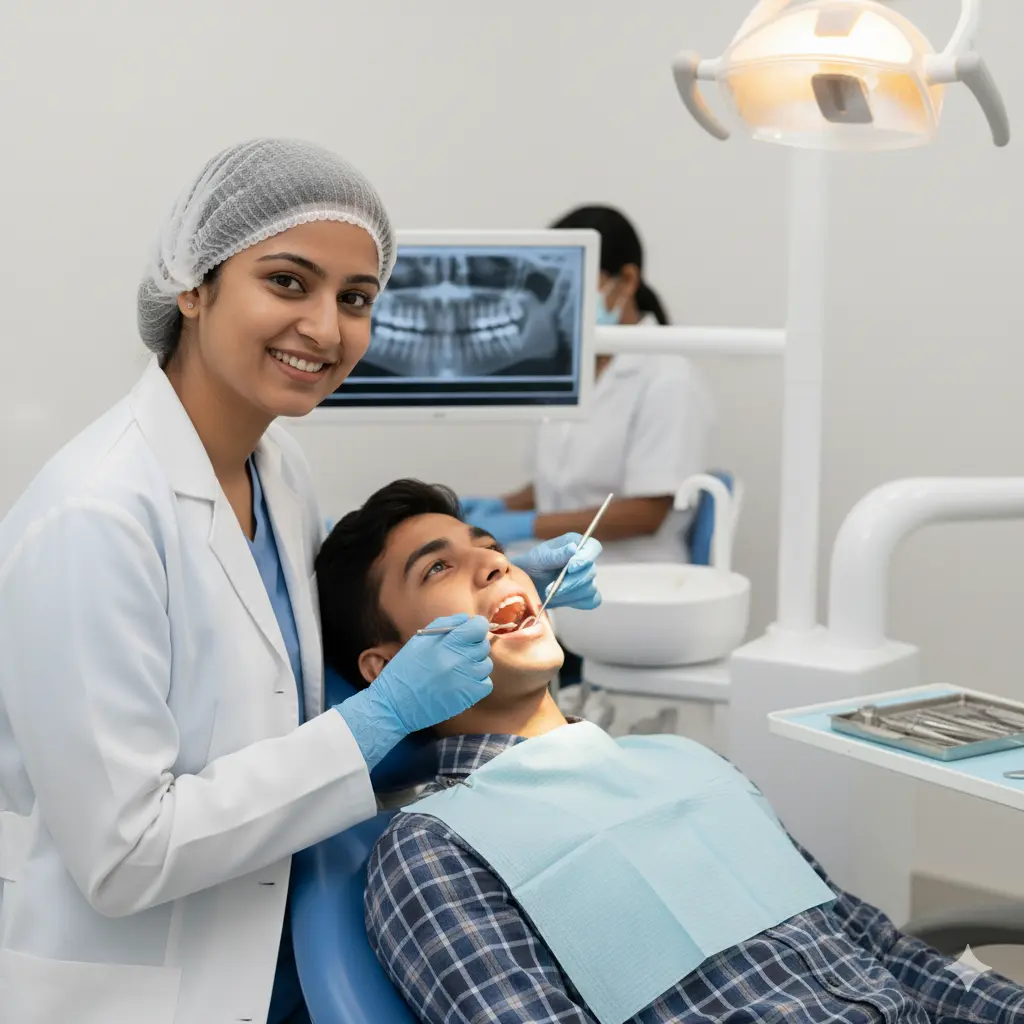
Orthodontic Dentistry Practices mainly uses both fixed and removable types of appliances. Both these appliances insert gentle perssure on the teeth and jaws to correct the teeth improportions. The severity of your problem actually determines which orthodontic approach is likely to be the most effective and suitable to you.
Braces: Braces are the most common fixed appliance on Orthodontic Practice and it consists of bands, wires and/or brackets. Bands are fixed around the teeth or tooth which work as anchors for the appliance. Brackets are attached to front surfaces of the tooth; while Arch wires are passed through the brackets and attached to the bands. Tightening the arch wire puts tension on the teeth and as a result the desired teeth/tooth gradually moves to the proper position. Braces are usually adjusted on monthly basis to bring the desired result, which may be achieved within a few months to a few years. Braces are available in Stainless Steel, Ceramic, etc… Now a day’s people prefer ceramic Braces more as it is transparent & clear giving similar shade to teeth.
Special fixed appliances/Habit Breakers: Special fixed appliances are used to control habits like thumb sucking or tounge thrusting, night clenching, mouth breathing etc… These appliances are attached to the teeth using bands.
Fixed space maintainers: Fixed space maintainers are used in a scenario when a milk tooth is lost prematurely, space maintainer is kept there to have enough space maintained to erupt the permanent tooth. Here a band is attached to the tooth next to the empty space, and a wire is extended to the tooth on the other side of the space.
Aligners: Aligners are used as an alternative to traditional fixed othodontic procedures that use a sequence of individual clear, removable “trays” to gradually straightent teeth. The alignment is accomplished with a series of trays which are computer-gerated based on proper records and diagnosis of your specific situation. This is mostly preferred bu adult’s busy professional travelling extensively, as it is more user friendly and can be removed for eating, brushing and flossing.
Removable space maintainers: These devices serve the same funciton as fixed space maintainers. They are made with an acrylic base that fits over the jaw, and have plastic or wire branchers between specific teeth to keep the space between them open.
Jaw repsitioning appliances: These are also called spints. These devices are worn either on the top or on lower jaw, or help train the jaw to close in a more favourable position. They may be used for temporomandibular joint disorders (TMJ).
Lip & cheek bumpers: These are designed to keep the lips or cheeks away from the teeth. Lip and cheek muscles can exert pressure on the teeth, and these bumpers help relieve that pressure.
Palatal expander: It is a device used to widen the arch of the upper jaw. It is a plastic plate that fits over the roof of the mouth. Outward pressure applied to the plate by screws force the joints in the bones of the palate to open lenghtwise, widening the palatal area.
Removable retianers: They are usually used as post methodology to fixed orthodontic procedures to retain the teeth in the corrected position.
Hedgear: Headgear is a device which is used externally over the face and slows the growth of the upper jaw. This device holds the back teeth where they are and while the front teeth are pulled back.
Chin Cap: Chin Cap is a device used externally over the chin to restrain the growth of lower jaw in Children with Prognathic chin to correct the malalignment of teeth.
WhatsApp us